100 Years of the Martha Graham Dance Company in Dance Magazine

In 1926, the pioneering modern choreographer Martha Graham founded her eponymous dance company. One year later, Dance Magazine (originally called The American Dancer) published its first issue.
The two institutions’ histories are twined together. Over the following decades, the Martha Graham Dance Company became a profoundly influential force in a dance world that was rapidly evolving; Dance Magazine became that world’s foremost chronicler. DM critics wrote passionately about some of Graham’s most memorable works. Photographs, essays, and the occasional interview with Graham herself illuminated the choreographer’s distinctive views on dance and its role in society. Graham and members of the MGDC appeared on numerous Dance Magazine covers.
As the Graham Company celebrates its centennial, a review of its coverage in the magazine reveals the scale of its influence—and how Graham’s works have resonated with dancers and audiences across generations.
1934

The critic Joseph Arnold started out a Graham skeptic, though he later came to appreciate her work. In a January 1934 review in The American Dancer he grudgingly noted the undeniable excitement around Graham and her distinctive style. “Whatever may be the ultimate judgment on Martha Graham’s dancing, historians will be obliged to state that in the year 1933, as in the years 1932 and 1931, this Martha Graham was the leading dancer in America,” he wrote. “Miss Graham is always the priestess and the stage is a temple. She dances as though in subjugation to a deity.”
1936
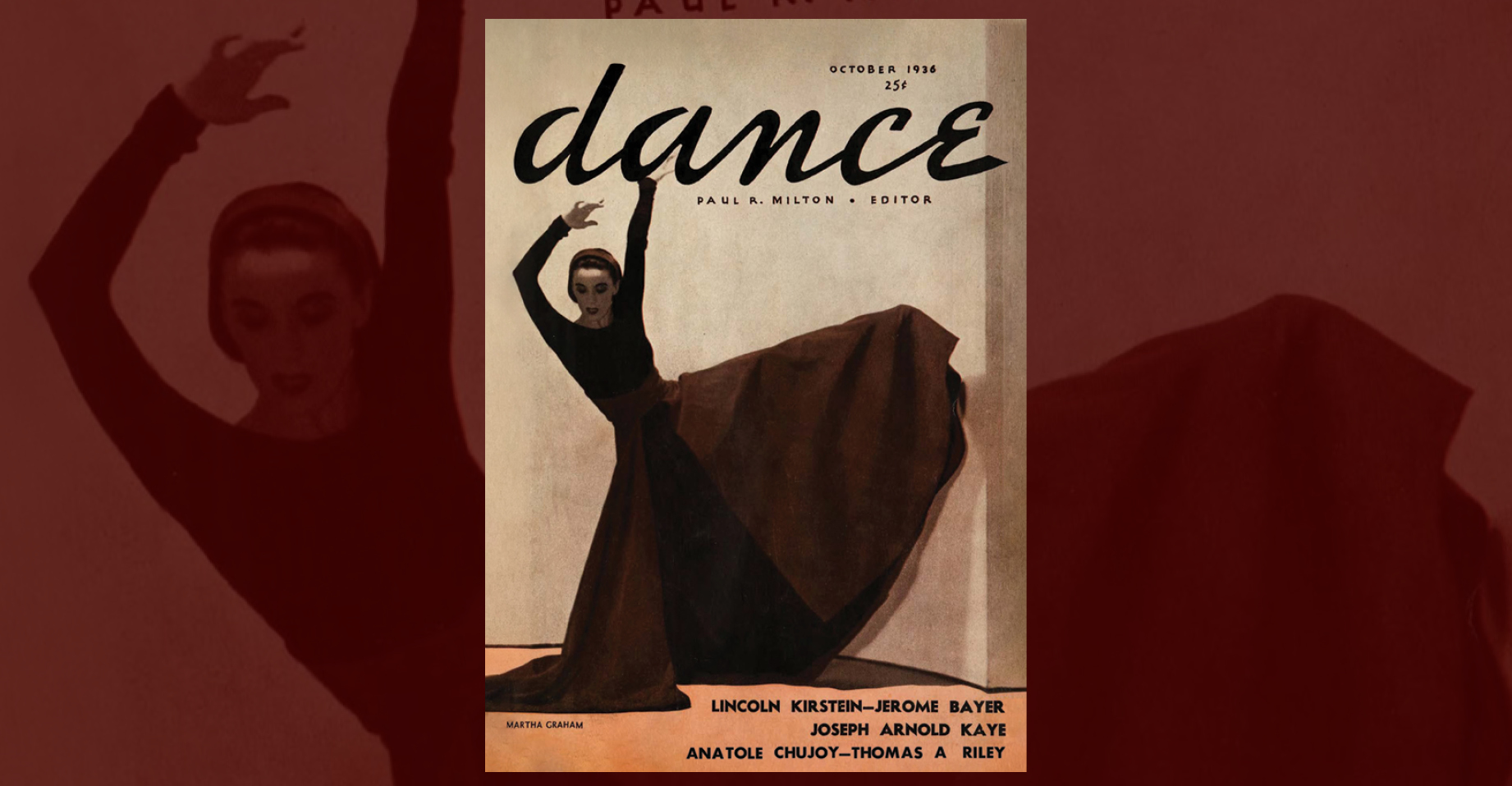
Volume 1, Issue 1, of the newly launched Dance Magazine, published October 1936, featured—who else?—Graham on the cover. The photo, by Ira D. Schwarz, captures Graham’s 1935 solo Imperial Gesture.

1939

Graham turned this ostensibly lighthearted May 1939 feature—the prompt was about pet likes and dislikes—into a bully pulpit. She gave her “thumbs up” to “a dance form which has its roots in the lives, customs, traditions and interests of one’s own people.” What got a “thumbs down”? “Pretentiousness and artiness,” she said, and “the dancing of slogans which might be displayed to better effect on banners!”
1946

In November 1946, the magazine recognized two recently premiered Graham dances as the classics they would become: 1944’s Appalachian Spring and the then-brand-new Dark Meadow (1946). A photo tribute celebrated the works’ “vitality of movement” and “emphasis on the dancing as a medium of expressing universal characterization.”
1959
The June 1959 issue immortalized Graham’s collaboration with George Balanchine on the ballet Episodes—a sign that the previously icy relationship between ballet and modern dance was thawing. Graham choreographed the first section of the work, which dramatized the story of Mary Queen of Scots, for dancers from her company as well as New York City Ballet; Balanchine created the second, plotless section for a cast that included the young Paul Taylor, then a dancer in Graham’s company. (Graham’s portion has since fallen out of repertory, although NYCB continues to perform Balanchine’s.) The cover features Graham rehearsing NYCB dancer Sallie Wilson and MGDC dancer Bertram Ross.

1965


By the 1960s, Graham was mounting restorations of some of her earlier works. The November 1965 cover features Graham dancer Yuriko Kikuchi, in a photo by Martha Swope, as the Virgin in 1931’s Primitive Mysteries, one of several revivals MGDC performed that season. LeRoy Leatherman wrote that the idea of looking backward was inherently anathema to Graham, who viewed her older dances “as though they were sea-shells grown to be lived in for a time, then shed,” Leatherman said. But works like Primitive Mysteries, Leatherman argued, are “indispensable to an understanding of her art, of the ‘holy jungle’ of her imagination, and of the progress of her private myth.”
1974


The July 1974 issue had a special section on Graham, which included a rapturous review of the MGDC’s recent New York City season and an analysis of her works’ female characters. Perhaps most striking was a collection of poetic excerpts from Graham’s own notebooks. “How does it all begin?” she asks in one passage:
“I supposed it never begins, it just continues—
Life—
generations
Dancing—”
“Life and death and that which connects them—love.”
1984


Heralded on the cover of the March 1984 issue as the “high priestess of modern dance,” Graham sat for a DM interview shortly before her 90th birthday. The hour-long conversation resulted, unsurprisingly, in many quotable quotes from Graham:
“There is a certain desire [the artist] has, a desire that is necessity. It is the inevitability of being caught in the whirl of things, caught in the immediacy of life, the importance of now….It’s a burden to have that desire, but it’s a great privilege.”
“The sources [of dances] are—what haunts you in a way, what dreams come to you. If you have not destroyed your intuitive acceptance and recognition of things, you have a chance. Of course if you’ve destroyed that intuitive thing, you’re finished.”
“I don’t think about what I have done; I only think of the things that I want to do, that I haven’t done.”
1989


The magazine marked Graham’s 95th birthday with an arresting cover—the barest sketch of her famous face—and another extensive interview, in which she demonstrated a softened attitude toward reviving her previous works. “Dance has changed and I have changed,” she said. “We live in a different time, but that is no reason for not reconstructing the dances of the past and performing them now.” Paraphrasing William Faulkner, she said, “The past is not dead; it is not even past.”
1991

Graham died on April 1, 1991. DM paid tribute to her throughout its July issue that year, with a complete list of her dances, memories from her colleagues and friends, and essays about her artistry. Yuriko said that “onstage, she was like the core of an atom bomb”; Paul Taylor quipped, “I thought I was Martha Graham—a lot of people do.” In his column on the magazine’s final page, writer Clive Barnes summed up the dance world’s feelings on her death: “Martha Graham can hardly die—it was not even in the small print of her contract with life. Death, as we know it, was for her more simply a transition of her genius from newspapers to history books, from legend to myth, from guru to tradition.”
1999–2013


What should Graham’s legacy look like after her death? Graham earned a posthumous DM cover in March 1999, as the magazine profiled four women who might be seen as her artistic heirs: Janet Eilber, Christine Dakin, Joyce Herring, and Terese Capucilli. The July 2005 issue checked in with the MGDC shortly after it settled its protracted legal battles with Ron Protas, Graham’s controversial legatee—the settlement allowed the company to perform Graham’s repertoire unencumbered. And DM’s November 2013 issue chronicled the evolution of MGDC in the ensuing years. The cover story described artistic director Janet Eilber’s efforts to keep the company financially and artistically sound, and celebrated the dancers keeping Graham’s flame alive, including cover star Xiaochuan Xie.
2020s


In the 2020s, three members of the next generation of Graham dancers graced the cover: Xin Ying, Lloyd Knight, and Leslie Andrea Williams. Though too young to have ever known Graham, in their respective cover stories, each spoke to the continued relevance of her work—to the urgency it still carries. As Knight said in his profile, when he discovered Graham, “I felt like I was watching Shakespeare in dance form. I loved it. I wanted to do it.”


