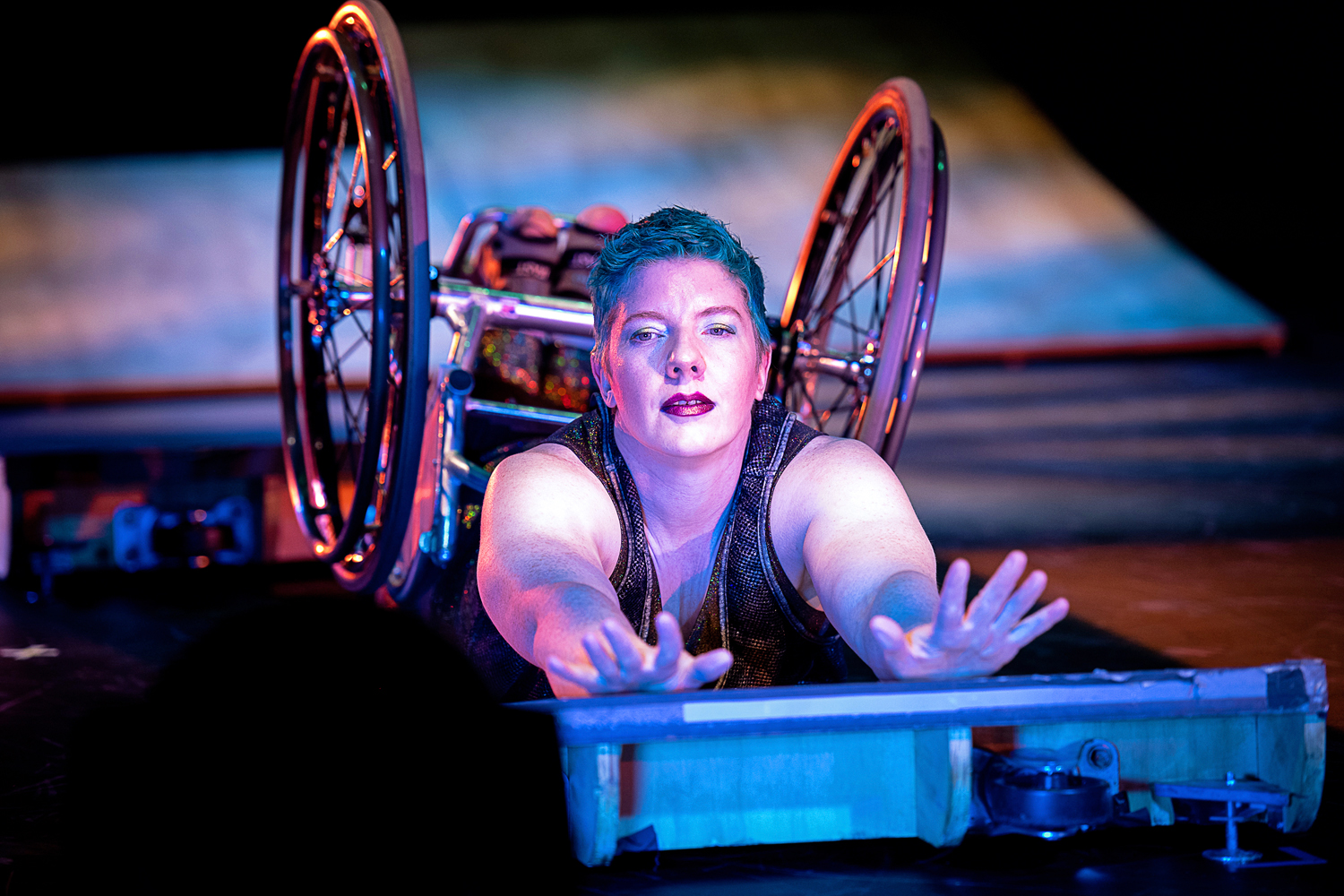
Audimance, Kinetic Light’s Multitrack, User-Choice Audio-Description App for Dance, Will Soon Launch in App Stores

In the final days of 2015, after a work-in-progress showing of Kinetic Light’s DESCENT, the company’s artist-engineer Laurel Lawson was approached by a group of blind and low-vision colleagues. “They said, ‘We missed stuff. There were times when we felt everyone in the audience leaning forward, or people gasping, but there wasn’t anything exciting happening in the audio description.’ So it was just utterly clear in that moment that this was completely inequitable,” Lawson remembers. For Lawson, the question then became: “How do we, as artists, fix this? How do we change our understanding of what dance is, not as a visual art but as a kinesthetic art that can be experienced sonically?”
These questions propelled Lawson and disability-arts ensemble Kinetic Light, alongside CyCore Systems, to develop Audimance, an app that offers users multitrack audio descriptions of performances. The company has used Audimance in select performances since 2017, and while a web-based version of the app is currently open-source and available on GitHub for venues and artists to use, Kinetic Light is gearing up for a wider release of a native mobile app if not later this year, then in early 2026.
Audimance offers multitrack audio description, allowing listeners to choose from, toggle between, and even mix different tracks, in contrast to the single description or interpretation that Lawson says is more typically offered. As the app’s framework has evolved over the years, Lawson and Audimance’s lead iOS developer, Colin Clark, kept many things in mind while refining its interface and offerings—in particular, ensuring the synchronization of each audio cue and its corresponding action in the performance. “If those moments don’t happen together, you might as well be at home by yourself—to know everyone else in the room is having an experience that you’re barred from is hugely damaging,” Lawson says. To establish this synchronization, artists select sync points in the audio-description tracks, which can then be triggered using the same production software used by stage management for other sound cues, such as the commonly utilized QLab, or Audimance itself. This allows stage managers to keep audience members listening to the descriptions up to speed with the action onstage. Audimance is also designed so that cues can be operated by another designated individual, and to accommodate live description.
While the current iteration will soon become widely available for iPhones via app stores (an Android version is also in the works), there are two yet-to-be-developed components that are intended to round out the Audimance ecosystem: an app and software package for venues, to ensure smoother implementation in any theater, and a “creator” app, which will assist independent choreographers and smaller companies. These applications are intended to be more user-friendly, streamlined, and fully integrated than the versions currently available for download and use by venues and artists.
“We’re certainly not the first people to do multitrack or spatialized sound,” Lawson says, “but we may be the first to do it specifically for the purposes of understanding how a physically embodied work can be natively interpreted as a rich sonic universe and an equitable listening experience for our nonvisual audiences.” The intentions of Audimance are what set it apart from other audio description tools and programs. “In many ways, we’re actually developing a new artistic media, and new fields of content.”
Throughout Audimance’s nine-year ideation and development process, the audience experience has always remained paramount to Lawson, Clark, and Kinetic Light. As they navigate expanding the app and its offerings, Lawson continues to return to the same questions: “How do we allow the audience to actually feel what it means to navigate kinesthetic choices themselves, to understand how their physical presence matters in a space, to understand the kind of physical relationship that two dancers in a studio have with each other? These things are all feeding into the ways I’m thinking about how to build these features, their user experience, and what to do next.”


